

Food at work is often discussed as though every requirement is the same. It is not. Supplying lunch every day for a large, shift-based workforce is a different task from organising a weekly team meal, breakfast before an all-hands meeting or food for client hospitality. All of these involve catering, but they solve different problems.
That is why organisations may hear two phrases used: employee feeding and workplace catering. They overlap. The important difference is the lens each term brings to the brief.
Employee feeding usually starts with provision: how do we make sure people can access suitable food, consistently and at the right volume? Workplace catering starts with the working day: what role does the food need to play, who is involved and what should the occasion make easier or better?
Understanding the difference helps organisations set a clearer brief and measure value beyond the number of meals ordered.
What does employee feeding mean?
In catering conversations, employee feeding is often used as shorthand for regular food provision for a workforce. It may cover breakfast, lunch, evening meals or refreshments, provided free, subsidised or paid for by employees.
The requirement is usually recurring and operationally led. It may involve:
- A staff canteen or cafe
- Delivered hot or cold meals
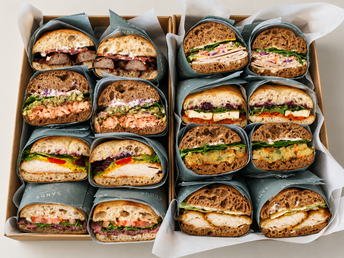
- Grab-and-go and pre-packed ranges
- Food for shift workers or multiple sites
- A fixed daily subsidy or price per person
- Predictable service windows and meal volumes
The priorities are clear: coverage, consistency, nutritional choice, food safety, allergen management, cost control and continuity. When hundreds of people need food at a set time, the systems behind the service matter as much as the menu.
HSE guidance requires employers to provide suitable welfare facilities, including somewhere to rest and eat meals. Providing food is a separate choice, but for many organisations it supports the workforce and keeps busy sites moving.
What does workplace catering mean?
Workplace catering is a broader idea. It can include regular employee meals, but it also covers the many other food occasions that happen around work: team breakfasts, collaboration-day lunches, meetings, training, client hospitality, seasonal events and workplace pop-ups.
The planning starts with the people, space and purpose. A working lunch should not disrupt the agenda. A team day may need a sharing format that encourages conversation. A recurring lunch needs variety while remaining simple to manage.
Workplace catering therefore considers three experiences at the same time:
- The people eating: choice, inclusion, quality and ease.
- The organiser: time, confidence, clear information and support when plans change.
- The organisation: cost, consistency, culture, hospitality and the outcome the food is there to support.
Employee feeding vs workplace catering: the practical difference
Four questions to ask before choosing a model
- 1. What is the food there to achieve?Begin with a recognisable need rather than a menu. Are you feeding a large workforce within a fixed break? Creating a regular moment for a hybrid team to eat together? Supporting focus during training? Welcoming clients? The answer should shape the format, service and budget.
- How predictable is attendance?
Hybrid working has made workplace demand less even. CIPD's 2025 UK research found that 74% of organisations had hybrid working in place, while 65% required a minimum level of workplace attendance. For catering, that means Tuesday may look very different from Friday, and a fixed daily model may not suit every organisation.
A good programme should flex around known office peaks, changing headcounts and the occasional last-minute request without creating unnecessary waste or administration. - Who carries the detail?
The person ordering often manages headcounts, delivery windows, budget, dietary requirements and internal communication. A model can still create too much work if ordering is unclear or every change requires several conversations.
Look for simple ordering, clear cut-off times, useful labels, one point of contact and a straightforward process for changes. Giving the organiser time back is part of the value created. - How will inclusion and safety be managed?
Dietary choice should not be added at the end. The Food Standards Agency requires food businesses to provide allergen information for prepacked and non-prepacked food, and its current best-practice guidance recommends written information supported by a conversation. - For workplaces, this means gathering requirements early, offering credible choices and making information easy to understand at the point of service. People should not have to make themselves conspicuous to find a suitable meal.
When an employee-feeding-led model is likely to fit
A more operational model may be right when:
- Food is required every working day or across shifts
- The workforce is large and attendance is predictable
- Service must happen within fixed breaks
- Multiple sites need consistent standard
- Cost per meal and waste control are central
- Hot counters, cafes or grab-and-go are part of the workplace infrastructure
Here, the strongest programmes are dependable, easy to replenish and supported by clear production, logistics and compliance systems.
When a workplace-catering-led model is likely to fit
A broader, more flexible model may be better when:
- Attendance varies across the week
- Food is concentrated on collaboration or team days
- Meetings and hospitality are part of the requirement
- Headcounts change regularly
- Variety and seasonal interest matter
- The business wants food to support connection, recognition or workplace experience
The service still needs discipline, but it is built around a more varied set of occasions.
Most organisations need a blend of both
The most useful distinction is not employee feeding or workplace catering. It is where each approach adds value.
A blended programme might provide lunch on two busy office days, pre-packed options for quieter periods, separate meeting food and occasional pop-ups. The organisation gets consistency without forcing every occasion into the same format.
A strong blended model usually includes:
- A clear core offer and service rhythm
- Enough menu variation to prevent fatigue
- Flexible ordering around changing attendance
- Meaningful dietary choice and accurate information
- Named support behind the ordering system
- Measures for uptake, waste, feedback and organiser time
The Sands Perspective
More than 50 years in food has taught us that workplaces rarely need a label; they need a model that fits the way their people actually work. The language and working patterns have changed, but the fundamentals remain: food must arrive safely, suit the people eating it and be straightforward to organise.
Today, our production and delivery systems support 12,500 meals a day across more than 250 active sites. That scale matters because it creates consistency. The human support behind it matters because no two workplaces, teams or working days are exactly the same.
In client-facing conversations, we often prefer regular workplace catering or workplace food programme. The wording reflects the full brief: providing meals, reducing uncertainty and creating occasions that work for everyone involved.
The Value Created
Consistent access to suitable food
Less administration and uncertainty for organisers
Better control of cost, waste and service standards
More inclusive food choices
Stronger support for meetings, team days and hospitality
A programme that can adapt as attendance and working patterns change
Greater value from food without asking it to solve problems it cannot solve alone
Planning workplace food?
Whether you need regular workplace catering, a daily food programme, meeting support or a flexible mix of services, start with the people, the working pattern and what the food needs to achieve.
Talk to our team and we will help shape a model that is simple to organise, supported by experienced people and built around the way your workplace actually runs.